

Summit Counselling Services — Children & Youth
Play TherapyChildren speak the language of play. We listen in it.
Play therapy gives children a developmentally appropriate way to process difficult experiences, express emotions they don't yet have words for, and heal — at their pace, in their language.

What Is Play Therapy
Not all healing happens through words — especially for children.
Children between the ages of 3 and 12 are still developing the cognitive and linguistic tools that adults rely on in talk therapy. When something difficult happens — a loss, a family transition, trauma, or persistent anxiety — they often don't have the vocabulary for it yet. But they have play. And play, for children, is not trivial. It is how they make sense of the world, try on roles, work through fears, and communicate what they cannot yet say in words.
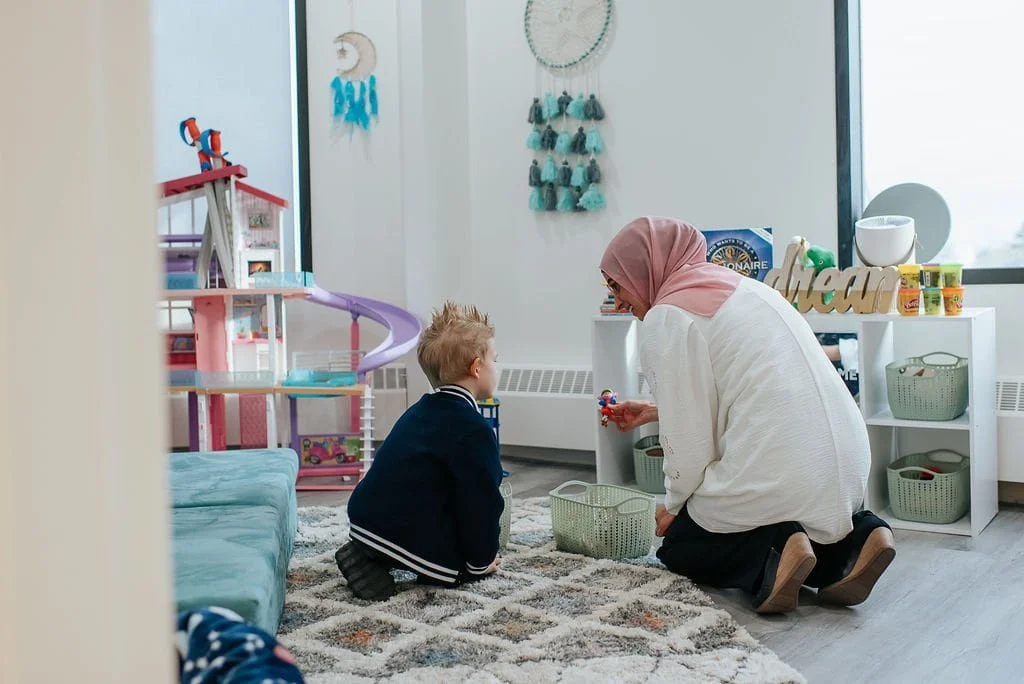
Play therapy is a clinically supported approach that uses play as the medium for therapeutic work. In a dedicated play therapy room — stocked with a sand tray, art supplies, puppets, building materials, and sensory toys — children communicate, explore, and process in the language that comes naturally to them. The therapist isn't there to direct or interpret the play mechanically. They're there to be a safe, attuned presence who follows the child's lead and creates the conditions for healing to happen.
Over sessions, patterns emerge. Difficult emotions find expression. And children develop greater capacity for regulation, connection, and resilience — often without ever being asked to explain what happened.
"Play is the language of children. It is how they make meaning of the world and process the things that are hard to say."
Who Play Therapy Helps
Children carry a lot they can't yet say.
Play therapy is effective across a wide range of childhood concerns — not just crisis situations. If your child is struggling emotionally or behaviourally, it may be the right fit.
Anxiety & Worry
Separation anxiety, school refusal, phobias, generalized worry, and somatic complaints that trace back to anxiety. Research shows 65–80% of children in play therapy show measurable reduction in anxiety symptoms.
Trauma & Adverse Experiences
Abuse, neglect, witnessing violence, accidents, medical trauma, and other experiences that leave a child feeling unsafe or shut down — communicated not in words, but in behaviour and play.
Behavioural Challenges
Aggression, emotional outbursts, defiance, and dysregulation that signal underlying unmet needs. Play therapy addresses the root, not just the surface behaviour. Research shows 60–75% improvement in behavioural problems.
Family Changes
Divorce, separation, blended family transitions, a new sibling, a significant move, or the loss of a family member. Children process these differently than adults — play therapy gives them a safe space to do so.
ADHD & Neurodivergence
Children who experience the world differently — including those with ADHD, autism spectrum differences, and sensory processing challenges — often thrive in the flexible, low-demand structure of the playroom.
Grief & Loss
The death of a parent, sibling, grandparent, or pet. A friend who moved away. The loss of a version of life that was expected. Play therapy gives children a contained space to grieve at their own pace.
Approaches We Use
Evidence-based modalities, child-led pacing.
Our therapists are trained in several evidence-based play therapy approaches, and tailor their work to the age, temperament, and presenting needs of each child. The therapist's role is to be a safe, consistent, attuned presence — following the child's lead rather than directing the work.
Every child is different. What works for one won't be the right fit for another. That's why our play therapists draw from a range of modalities rather than applying a single model to every child.
Specific Approaches
What your child's therapist may use — and what each one does
These approaches are often integrated together, tailored to each child's developmental stage and presenting concerns.
Child-Centred Play Therapy (CCPT)
The most widely researched play therapy approach. The child leads completely; the therapist follows. CCPT creates unconditional acceptance and accurate empathic reflection, allowing the child to work through whatever is most pressing in the way they choose. Supported by decades of research and multiple meta-analyses.
Sand Tray Therapy
Children create miniature worlds in a sand tray using small figures — a projective technique that allows symbolic expression of internal experiences that are difficult to verbalize. Sand tray is particularly effective for trauma processing and children who resist more directive approaches.
Trauma-Informed Play Therapy
For children who have experienced trauma, play therapy is integrated with trauma-sensitive and somatic techniques that work with the nervous system. This approach prioritizes safety and titrated exposure — helping children process at the pace their system can tolerate.
Expressive Arts Therapy
Drawing, painting, clay, collage — art gives children a non-verbal outlet that externalizes internal experience and gives the therapist a window into the child's inner world. Particularly useful for children who are resistant to talking or who struggle with verbal emotional expression.
Theraplay
A structured approach that uses play activities to build healthy attachment, trust, and regulation between child and caregiver. Theraplay involves both the child and parent, directly addressing the relational patterns that underlie the child's difficulties.
Filial Therapy / CPRT
Parents are trained to conduct structured special play sessions at home, deepening the therapeutic relationship between child and caregiver. Research consistently shows filial therapy produces stronger outcomes than clinic-only treatment — with effect sizes significantly above therapist-only play therapy.
For Parents
The most powerful therapeutic agent in a child's life is you.
Filial Therapy — also called Child-Parent Relationship Therapy (CPRT) — trains parents to conduct structured play sessions at home using core play therapy skills: empathic listening, following the child's lead, setting therapeutic limits, and building self-esteem through the relationship.
Research consistently shows that filial therapy produces stronger outcomes than therapist-only treatment. When parents become active participants in the therapeutic work, the healing extends beyond the 50-minute session into the daily life of the family.
Our CPRT-trained therapists work with individual families in a 10-session model — teaching skills progressively, with supported home practice between sessions.
Book a Parent ConsultationEffect size for filial-trained parents, significantly above d = 0.72 for therapist-only play therapy
Sessions in the CPRT model — structured, progressive, and designed for real family life
Weeks by which many families in filial therapy report measurable improvement at home
Range where filial therapy is most strongly supported by research evidence
"When parents become the therapeutic agents, the relationship itself becomes the treatment."
Our Play Therapists
Trained, registered, and genuinely good with kids.
Our play therapists hold graduate-level training in child and play therapy and are registered with the College of Alberta Psychologists or Alberta College of Social Workers. They work collaboratively with parents throughout the process.
Common Questions
What parents usually want to know
Book a Session
Three locations across Edmonton and St. Albert
Your child doesn't have to have the words. That's what the playroom is for.
A free 15-minute phone consultation helps us understand what your child is going through and whether play therapy is the right fit. No commitment, no pressure — just a conversation.
Summit Counselling Services operates on Treaty 6 Territory, the traditional lands of the Cree, Nakoda, Saulteaux, and Métis peoples. We are grateful to live and work on this land, and we are committed to supporting the wellbeing of all who call it home — including the children, youth, and families from Indigenous communities we are honoured to serve.