

Summit Counselling Services — Specialty
Couples Therapy & Marriage CounsellingEvery relationship hits hard patches. It doesn't mean you're failing.
Whether you're navigating conflict, rebuilding after a rupture, or simply want to strengthen what you already have — couples therapy gives you a skilled third party and a safe space to work on it together.

About Couples Therapy
Does any of this sound familiar?
You and your partner keep having the same argument. You're talking but not really hearing each other. You've both gotten so caught up in the day-to-day that intimacy — emotional or physical — has quietly slipped down the list. Or maybe there's been a breach of trust, and you're wondering whether it's possible to rebuild.
Maybe things aren't dramatic at all. Maybe you're newly together and want to start on solid ground. Maybe you're navigating a major transition — a move, a new baby, a loss, a career change — and the pressure is starting to show.
Over time, our individual histories, values, and attachment patterns inevitably bump up against each other. The way you were loved growing up shapes the way you give and receive love now. When those patterns clash — and they always do, eventually — it takes more than goodwill to work through them. It takes skill, and sometimes it takes support.
That's what couples therapy is for. Not to assign blame, and not to fix one person or the other. To give you both a space where you can actually be heard, and a skilled guide who can help you understand what's happening underneath the surface.
You don't have to be in crisis to benefit
Many couples wait until things feel dire before seeking support. In reality, the earlier you start, the more effective therapy tends to be. You can seek couples therapy at any stage — before challenges become serious, or when they already have.
All relationships welcome
Our therapists work with couples of all configurations, orientations, and relationship structures. Whether you are married, common-law, long-distance, or exploring non-traditional arrangements, you are welcome here.
The issue is the issue
Our therapists are trained to ensure both partners feel seen and heard. We don't take sides — instead of viewing one partner as the problem, we view the problem as the problem. It's not you vs. them. It's both of you vs. the challenge.
When to Seek Support
Couples come to therapy for many reasons
There's no threshold you need to cross before reaching out. These are some of the most common reasons couples seek support — but if yours isn't on this list, that doesn't mean therapy isn't for you.
Communication Breakdown
You feel unheard, misunderstood, or like every conversation ends in conflict. Arguments go in circles and nothing gets resolved. The same issues keep resurfacing no matter how many times you've tried to address them.
Infidelity & Betrayal
Whether emotional or physical, infidelity leaves a deep wound. Rebuilding trust after betrayal is possible — but it's a process that requires skilled support for both partners. Therapy provides a structured, safe path through it.
Intimacy & Connection
You've drifted apart. Sex and intimacy have become infrequent or fraught. You feel more like roommates than partners. The emotional warmth that used to come easily now feels effortful or absent.
Major Life Transitions
A new baby, a move, a career change, a loss — major transitions put pressure on even strong relationships. Couples therapy can help you navigate change together rather than letting it drive a wedge between you.
Blended Families & Parenting
Differences in parenting philosophy, step-parenting dynamics, and the challenge of blending two families are among the most common — and least discussed — sources of relationship strain. Therapy creates space to work through them.
Proactive Strengthening
Some couples come to therapy not because anything is wrong, but because they want to build a stronger foundation before challenges arise. Pre-marital counselling, for instance, can give you tools and language that serve you for years.
The Process
What to expect in couples therapy
Structure varies by therapist, but here's how the process typically unfolds at Summit.
Separate Intakes
Both partners complete intake forms separately — so each person can share honestly without the other seeing their responses. This sets the tone for a process where both of you feel safe.
Joint First Session
Your first session is together. You'll discuss your goals for therapy, what's brought you here, and what you're hoping to build or repair. Your therapist listens to both of you equally.
Individual Sessions
Many therapists schedule brief individual sessions with each partner to better understand your separate histories, attachment patterns, and perspectives. This informs the work you do together.
Ongoing Joint Work
The majority of sessions are held together. What you work on depends on your relationship's specific needs — communication, trust, intimacy, conflict resolution, or the underlying patterns driving all three.
Therapeutic Approaches
How our therapists work with couples
The specific tools and approaches vary by therapist and by couple — but these are the frameworks our clinicians most commonly draw on in couples work.
The Gottman Method
Based on decades of research into what makes relationships thrive or fail, the Gottman Method gives couples practical tools for reducing conflict, deepening friendship, and building shared meaning. It's particularly well-suited for couples who want concrete strategies alongside the emotional work — and for those dealing with gridlocked conflict or erosion of trust.
Emotion Focused Therapy (EFT)
EFT for couples focuses on the emotional bond between partners and the negative interaction cycles that erode it. Developed by Dr. Sue Johnson, it helps couples access and share the deeper emotions — usually fear, grief, or longing — that drive surface conflict. EFT is particularly effective for couples experiencing emotional disconnection and attachment injuries.
Cognitive Behavioural Therapy (CBT)
CBT for couples addresses the thought patterns and behavioural cycles that escalate conflict. It helps both partners recognize the triggers and automatic interpretations that fuel tension, and builds concrete skills for de-escalation and more constructive communication before conflict spirals.
Attachment-Based Therapy
Our individual attachment histories — how we were loved (or not) early in life — shape how we give and receive love as adults. Attachment-based approaches help couples understand the deeper relational wounds driving their patterns, and build the kind of secure connection that allows both partners to feel genuinely safe.
Sex Therapy
Intimacy is a core part of most romantic relationships — and one of the most common sources of unspoken tension. Several of our therapists specialize in sex therapy for couples, providing a comfortable, skilled space to address desire discrepancy, intimacy avoidance, sexual concerns, and the impact of trauma or life transitions on sexual connection.
Relationship Counselling
Not every couple comes in with a specific presenting concern — sometimes the goal is simply to improve the quality of the relationship, strengthen communication habits, or work through the ordinary friction of building a life together. Relationship counselling meets you where you are, whatever that looks like.
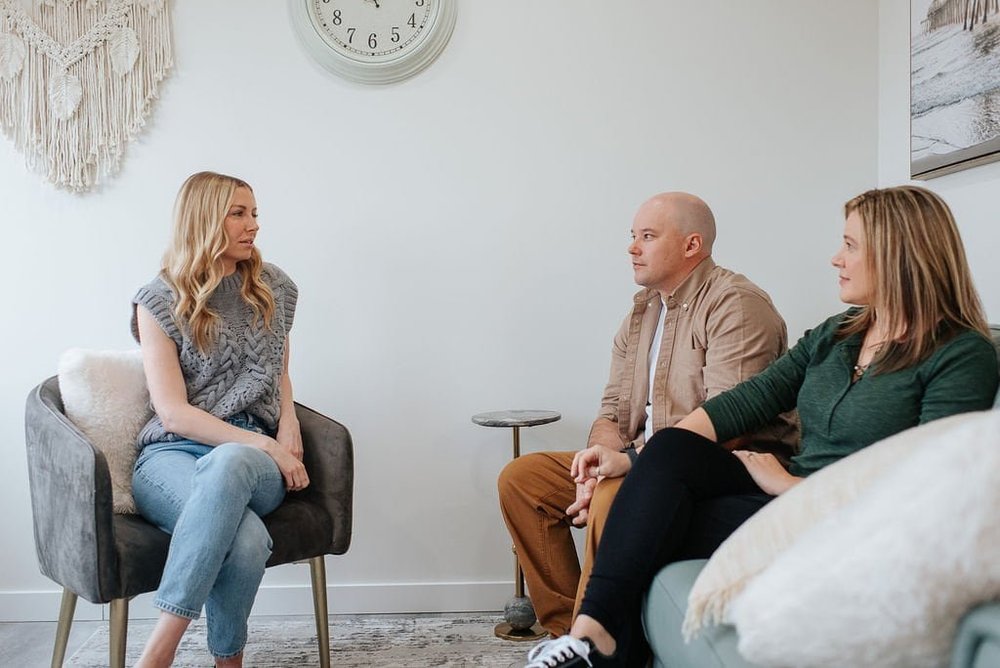
Why It Works
Therapy can help couples fall back in love
Many couples imagine therapy as a last resort — something you do when you're on the brink of ending things. But the research suggests the opposite: the earlier couples seek support, the better the outcomes. Creating a strong relational foundation before challenges become serious gives you the tools to weather the inevitable rough patches with more skill and less damage.
That said, if you've waited a long time — if things already feel far gone — therapy can still help. It provides a safe, non-judgmental space where both of you can feel heard and understood, and where a skilled third party can help you see patterns that are almost impossible to see from inside them.
"The goal isn't to never have conflict. It's to have conflict in a way that brings you closer rather than further apart."
Common Questions
Couples therapy — your questions answered
Our Specialists
Therapists who specialize in couples counselling
The clinicians below specialize in couples and relationship therapy. Use the Find Your Fit tool to explore further, or start with a free 15-minute phone consultation before booking your first session.
Related Support
Other areas we work with
Book a Session
Find us in Edmonton, St. Albert & Windermere
All three locations offer couples therapy in person, with virtual sessions available for clients anywhere in Alberta.
Wîhkwêntôwin ᐄᐧᐦᑫᐧᐣᑑᐃᐧᐣ (Oliver)
Grandin Plaza, 2nd Floor
Southwest Edmonton
You built something worth fighting for. Let's work on it together.
Your first phone consultation is free — no commitment, no pressure. Just a conversation about where you are and whether we're the right fit for you both.
We acknowledge that our practice is located in Treaty 6 territory, on the traditional lands of the Cree, Saulteaux, Niitsitapi (Blackfoot), Métis, and Nakota Sioux Peoples, including our Brewery District office in Wîhkwêntôwin ᐄᐧᐦᑫᐧᐣᑑᐃᐧᐣ (Oliver). We recognize that healing and reconciliation is a responsibility shared by all.